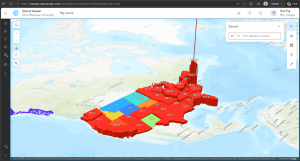
Chapter 7 covers the 3D uses and types used in ArcGIS. 3D maps allow for a better understanding of presented data, improving communication, visualization, and analysis. There are two types of 3D map types in ArcGIS: cartographic and photorealistic. Each of these types have their own uses in different cases. Photorealistic provides a direct, real-world view of the presented area and would be more useful in areas such as architecture or infrastructure, while cartographic is better at portraying abstract ideas or values, being more useful in cases covering a larger area, such as showing populations of counties or states. 3D mapping has a multitude of uses with both visualization types (photorealistic and cartographic) and can be utilized in a wide variety of cases. From interior design, interactive digital situations, plumbing, game design, artistic interpretation, environmental protection, and many, many other situations. There are endless possibilities and utilizations of not only the basic 2D mapping in ArcGIS but also the more immersive and complex 3D mapping and visualizations.
The ideas introduced in Chapter 7 can be applied by combining a cartographic map of an apartment complex’s resident population and a photorealistic map of the lots. This can help provide a landowner with an idea of why certain locations are more sought after than others. Things like the apartment’s view, closeness to highways/major roads, ease of entry, and other factors can play into this and be seen from the photorealistic map. The cartographic map will help with seeing trends of desired locations around the complex.