Chapter One
The most important part of this chapter for me was the statement about what GIS analysis is, “lets you see patterns and relationships in your geographic data.” However, I find it difficult to read all of this and not have practice with it right away. There is so much to this. I truly feel like I do not understand what this is all about. One point the text made is that using analysis will give you insights to focus your study of different areas. GIS helps with trends and patterns. I liked the example of the process that is followed. It is similar to the scientific method: Framing the question, understanding the data, choosing the right analytical method, processing the data, then examining and interpreting the results to create your conclusions. The vector vs raster representations confused me a little. Discrete values which are specific points or lines are usually represented with vector data. Continuous data are usually represented with raster. However the text notes that any feature can be represented using either method. Discrete values that are in layers may use raster as well. However, when looking at some of the examples, I didn’t see much of a difference. The various attributes section was much easier to understand. These descriptors give meaning to different patterns. I think overall, my problem with reading through all of this is that there is a disconnect between the reading and actually experimenting with the software. It is clear however, that GIS isn’t just playing around with maps, it is a methodological approach to understanding the data provided by the maps.
Chapter Two
Mapping Where Things are helped explain how we will make our own maps. One point that the book made that stood out to me is that we should only put on the map what needs to be displayed so it doesn’t take away from the overall effect of the map. What is actually mapped is decided on the purpose of the map and who will be seeing it. When preparing the map each feature will need to have coordinates. Sometimes these coordinates are in the software, but sometimes they have to be hand entered. When different features are mapped by type, you create a symbol for each type. If that map only has one type of data, all the points will use the same symbol. However subsets help show more patterns. Sometimes it may be necessary to create two maps so that it is easier to discern what is being shown. One thing I really took away from this chapter is that there should be a limit of seven categories. More than that gets confusing for viewers. However, too few categories may not make the point you are trying to show with your map. Another point the text made was that the creator needs to be careful that the map is portraying what they are after. This chapter did help clear some things up for me and help with the feeling of being overwhelmed. The emphasis on preparing the data seems tedious, but choosing the symbols and categories seems interesting. I also like that the chapter talked about how different colors and widths of lines can be very helpful. I thought it was interesting that it said that printed maps are easier to see than those on a screen, but I would argue that with many screens today, it may be easier to view on a screen.
Chapter Three
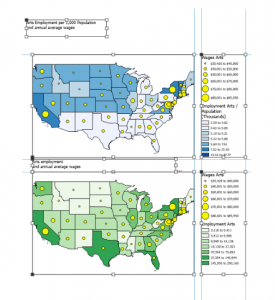
Chapter three builds on Chapter two significantly. The purpose of what you are doing helps you determine how to present the information of a map. For example, you may just be looking at the given relationships, but you may be trying to show a specific pattern. When mapping quantities such as the most or the least of something, this helps to not only see relationships, but also to make decisions based on those relationships. There are different quantities to consider in mapping, depending on what you are trying to portray. There are counts, rations, and ranks. These need to be represented in different ways. I liked how the book points out that knowing what you are mapping helps you present it. The new concepts to this chapter are about classification. Natural Breaks, Quantile, Equal Interval, and Standard Deviation are discussed. Jenks was a new word for me. Each of these classifications are important, but selecting the one that fits what you are presenting is important. Symbolization and cartographic displays are also a part of this chapter. This is the concept of choosing the elements that help to visually represent the data how you want it represented. Once a map is mad, patterns should be looked for as well as outliers. I like how the chapter helps me understand how the maps are up to interpretation. However, the choices made for a map communicate many things. Making the map visually pleasing is extremely important because it weighs heavily in how viewers are able to interpret the data.