Deem week 3

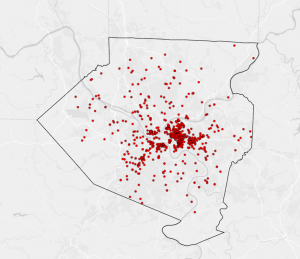
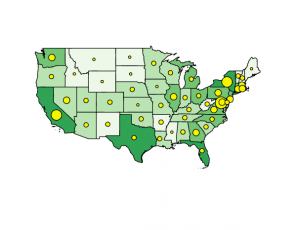
Chapter 4: I found chapter 4 interesting because it discusses density mapping and its various applications. This type of mapping is very common because of how useful it is to find patterns in data, and is versatile for this purpose. Density maps can be made from all sorts of data, and can even be made from both features and feature data. In terms of visualization, they can be displayed as dot maps where a dot represents a single instance (or a set number of instances) of the phenomenon being recorded, or as shaded areas where each area has a different shade indicative of the frequency of the phenomenon being recorded in that area. Shaded areas can also be more abstract shapes not defined by manmade borders, such as in a map showing something like rainfall which is not confined by human borders. Dot maps must be considered more carefully than shaded area maps because it is important to choose a value for each dot that allows for the distribution of the data to be clear. For example, you would not want to choose a value so low that the dots appear as one singular mass, but you would not want to choose a value so large that it is unclear which area is being represented. Additionally, depending on the size of the dots, the thickness and detail of borders must be taken into consideration. Because the dots can be obscured by border lines, they should not be too thick and you may want to consider if the borders are useful to the viewer and not include them if they would not be useful in understanding the data. In conclusion, density maps are not very complicated but have various applications for all sorts of data, making them useful in a variety of situations.


Chapter 5: Mapping what’s inside seems to have applications in determining whether action needs to be taken based off of the data that has been collected, and can be used to find patterns in data. Similar to other types of mapping, the data can either be discrete or continuous, which is an important factor to consider when making a map of this type. There are three ways of mapping what’s inside – drawing areas and features, selecting the features inside an area, and overlaying the areas and features. Drawing areas and features involves creating a map showing the boundary of an area and the features that are inside the area. It is a simple method useful for determining if features are inside or outside an area. If the areas being used are discrete, the data can simply be overlaid on top of the area to show the information. For continuous data, a map of the data is first made and a map of the defined area is overlaid onto it. Selecting the features inside an area uses GIS to summarize the features inside of an area. The results that have been collected from a map can be made more concise and understandable by the GIS, using tools like statistical summaries to display the information from the map in a way that is quickly discernable. Overlaying the areas and features uses GIS to combine layers on a map, displaying the overlap between the areas and the features (or lack thereof). This method is useful when dealing with discrete features, however it can also be used when dealing with continuous values. In conclusion, this type of mapping is somewhat complex but can be useful in more specific situations. Each type of mapping what’s inside has its own situations where it is more viable than other forms of mapping.


Chapter 6: Finding what’s nearby is about making maps in order to determine if something is in an area around a selected point, or how much of something is near the point. An important aspect of this type of mapping is whether or not travel is involved. If it is, factors like travel cost and distance may need to be taken into account in the case of something like a tourism guide. Something I found interesting about this chapter is that in some cases it is necessary to take into consideration the curvature of the earth. I had never considered that this would be something map makers had to work around, but it makes sense. As with all maps, finding what’s nearby requires you to know what sort of information needs to be gathered from the map. This will influence how the map is made, for example the mapping of taxi routes in a city would require a different type of map than intercontinental airplane maps which would need to consider the aforementioned curvature of the earth and would result in a different type of map. There are three ways to find what’s nearby. Straight-line distance creates an area around a source point of interest using the distance being measured as the radius of a circle. Distance/cost over a network is slightly more complicated, requiring a source location and a distance or travel cost to be specified. Then, the GIS determines which areas are within the distance or cost. Cost over a surface also requires a source location and a travel cost, and shows the cost proportionate to the distance away from the source location. This type is useful when considering how the distance being traveled will affect the target that is travelling. Finding what’s nearby is similar to mapping what’s inside, but has a greater focus on distance and travel cost. 


Deem Week 2

Mitchell Chapter 1:

This chapter helps highlight some of the basics to begin getting into GIS software and digital mapping in general. It starts out by guiding the reader through the process of using GIS to create a map by first understanding the data that will be used to create the map. Next, you have to choose a method to present the data based on the purpose of creating the map in the first place. The data must then be processed through GIS software to be displayed as a map, which can be tweaked by the creator in order to display the information in the most appropriate way for the situation. This chapter also goes into detail about several important terms related to GIS. Geographic features are map items that can be described as either discrete (definitely occurring or not occurring in a given position) or continuous (intensity of occurrence varies based on position). Another important term described in this chapter are the two different ways of representing geographic features in GIS, which are vector and raster. Vector models describe features on a map using x,y coordinates and connecting them with lines and can be used to show the location of specific events. Raster models were a bit harder for me to understand, although it seems they use a grid-like pattern of cells to describe an area and use different layers of this area to show where events have occurred. Overall I thought this chapter provided a lot of useful information to get started with GIS, although I would also say that the wording was very technical and difficult to understand at times. The pictures and figures that were provided helped make some of the terms and ideas easier to understand, although I also had trouble figuring out what was being represented at times.


Mitchell Chapter 2: This chapter outlines the reasons for creating maps and how they can be useful to ascertain patterns in data, as well as providing information on how to create maps that are easier to understand. This information proves useful in certain career fields such as police, ecology, and urban planning, although there are applications in almost every field. This chapter also discusses the ways to properly create maps in a way such that the level of detail included is appropriate for the topic being discussed/the purpose of the map. The example given in the book is a city council meeting where the location of heavy industry in relation to high density housing (requires precise detail) versus a meeting on overall zoning patterns in the city (requires significantly less detail). Also included in this chapter is how to map by types and categories. To map by types, the topic of the map is first determined (such as crimes) and each subset of the overall topic is given its own designation with a specific symbol or color. To map by categories, features of the map are also depicted with different symbols, although categorial maps typically offer the viewer a greater understanding of how a system works. In the case of road maps, the viewer can discern the general function of the different types of roads based on their location in relation to other roads or buildings if provided. A piece of information I found useful in this chapter was the small section about including reference features in maps in order to appeal to a broader audience. The author suggests using these features so that the viewer can understand the locations of map items easier. I thought this chapter included its information in a more digestible way compared to the previous chapter and I was able to understand the concepts presented easier.


Mitchell Chapter 3: This chapter was dense with information I found interesting and useful. A key concept in this chapter is the idea of “most and least” – information on a map that shows where the most and least of an item occurs. I think that this concept will appear often because there are many possible applications for it in different fields and scenarios. Another piece of information I thought seemed important from this chapter was the difference between creating a map for the purpose of scrutinizing data as opposed to creating a map for the purpose of presenting information to an audience in an understandable manner. Counts and amounts refer to the numerical value associated with features on a map, with counts being the actual number of features on the map and amounts being a measure of some value associated with the feature on a map such as percentages. Something that surprised me while reading (although it probably shouldn’t have) was the appearance of statistics in relation to maps. While I was reading I started to remember all the times in my high school statistics class where maps were brought up in problems. I think the portion toward the end of the chapter about creating maps will be useful when we start using GIS, particularly the part where it discusses how only necessary information should be displayed so as not to overload the viewer with redundant or useless information. I think it will be an important part of the map creation process to go back and revise our maps so that they provide the required information in a concise and focused manner. When I initially saw the pictures of the 3D maps at the end of the chapter I thought that they might be really challenging to create, but after reading I don’t think they will be as difficult as I initially assumed.


Deem week 1

I have completed the GEOG 291 quiz

Hello! My name is Andrew Deem and I am a freshman at OWU this year. I am from Marion, Ohio which is about a 30 minute drive from campus. I plan to major in botany with a minor in environmental studies because I love plants and the outdoors. I am looking forward to participating in this class and learning more about geography!

Schuurman: This chapter of the book was useful to me for several reasons. Because this is a topic I know very little/no information about, this chapter was able to bring me up to speed on the entire landscape surrounding GIS with a brief summary of its history and how it was gradually developed and accepted in the mapping community. There were times when I was reading that I would be struck with a lot of jargon from this topic that meant little to me, but the author does a good job at providing enough context clues so that an inexperienced reader is able to discern the information anyways. Additionally, I found it interesting how the story of the development of GIS was being told in a way that directly linked it to advancements in computing technology, which made it easier to follow the timeline of events. From this chapter I was also able to gain a greater understanding of how GIS is useful in displaying data in the form of visual information, making it easier to understand. I can appreciate how valuable GIS must be, because I personally see the maps it creates often on the internet. Overall, this chapter taught me about how complicated GIS can be, both GISystems and GIScience are very complex fields which are very important parts of our society and have taken a lot of effort and time to get to the point they are at today. Much of the complexity comes from just how broad this subject is, as while it is foremost a field that specializes in creating maps, it is easily overlooked that ‘creating maps’ in this way requires knowledge on the topic the map is being based on. Because of this, GIS is a highly valuable field that is important to modern life.

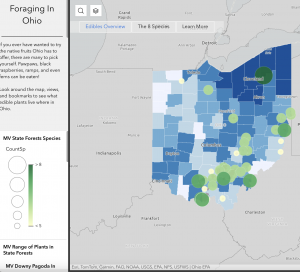
GIS application 1: https://experience.arcgis.com/experience/6933ac08a46d43a0a36372cba29299f1


For my first GIS application, I was able to find a map of edible plants that can be foraged across Ohio, and interestingly enough it was on ArcGIS Online. This directly ties in with my interests of native plant taxonomy and foraging.


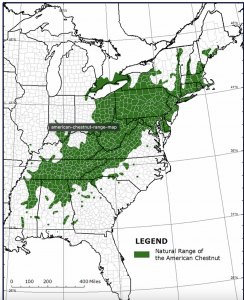
GIS application 2: https://tacf.org/american-chestnut-range-map/

For my second application of GIS I decided  to find a map displaying the native range of the American chestnut tree, which has been destroyed by an invasive fungus over the past century.