1. Introduction: My name is Hunter Rhoades and I am a Junior majoring in Public Health, Nutrition, SOAN, and Educational Studies with a minor in Biology. As an aspiring epidemiologist, I figured that this course would be great to take – as GIS is often applied to outbreak investigations to identify disease clusters. I am from Zanesville, Ohio which is home to the infamous Y Bridge and Tom’s Ice cream Bowl. Moreover, I’m an RA on campus, a Cooking Matters Coordinator, and involved in our university’s Food Recovery Network. I look forward to see how I can utilize GIS and apply it to the field of public health/epidemiology!

2. Schuurman Chapter 1: I find it really interesting that GIS is being utilized for areas other than geography. For example, I have seen GIS being utilized by Registered Sanitarians at fairgrounds to map which food trucks have passed inspection, failed inspection, or have yet to be inspected. I find the linkage between GIS and public health to be very interesting, as the application allows for quicker visualizations and saves time. I was interested to read about how GIS allows planners to identify residential, industrial, and commercial zones by mapping the exact location and survey coordinations of each taxable property. This allows planners to see impacts on a larger scale in a way that may be hard to do via data analyses or groundwork.
I was very interested in reading about the differences between spatial analysis and mapping, because I have always thought that the two were interchangeable. I learned that spatial analysis generates more information or knowledge than can be gleaned from maps or data alone. On the other hand, mapping represents geographical data with varying degrees of fidelity, in a visual form. It does not create more information than was originally provided, but does provide a means for the brain to discern patterns. To my understanding, spatial analysis is analysis on a deeper level beyond visuals, while mapping just provides visuals.
I was very interested to read about how John Snow utilized mapping during the 1854 Cholera outbreak. This example emphasizes the importance of mapping, as the author states that 50% of the brain’s neurons are used for visual intelligence. Visualization in conjunction with analysis can be a power method to discover outbreak clusters– in other words, visuals can tell stories that allow for researchers/analysts to uncover data/key details about the visual. I believe that the evolution of GIS is essential to uncover trends in data more quickly and precisely.
3. GIS Application 1: SARS Cases Distribution in the World
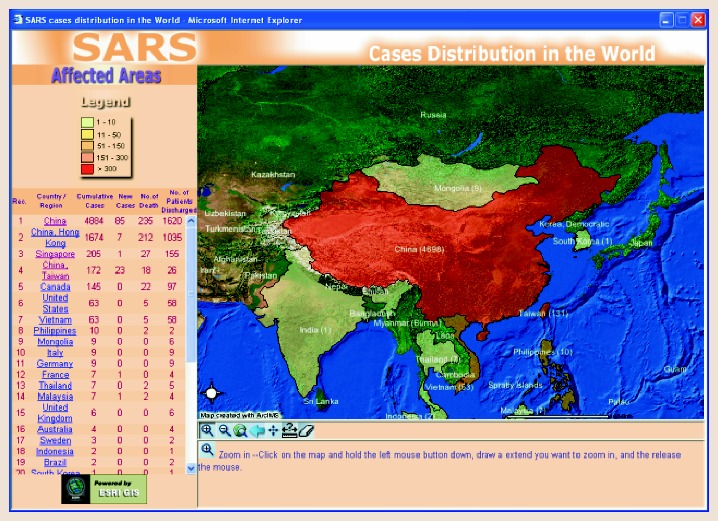
This source discusses the evolution of the application of GIS within Health and Human Services. During the SARS outbreak of 2003, WHO and Hong Kong Department of Health launched an interactive website mapping application to provide current, accurate information on the distribution of SARS in China and surrounding areas. These mapping efforts educated the public and travelers, assisted public health authorities in analyzing the spatial and temporal trends and patterns of SARS, and helped authorities assess and revise control measures.
Source: https://pmc.ncbi.nlm.nih.gov/articles/PMC7121355/
4. GIS Application 2: Emergency Department Usage
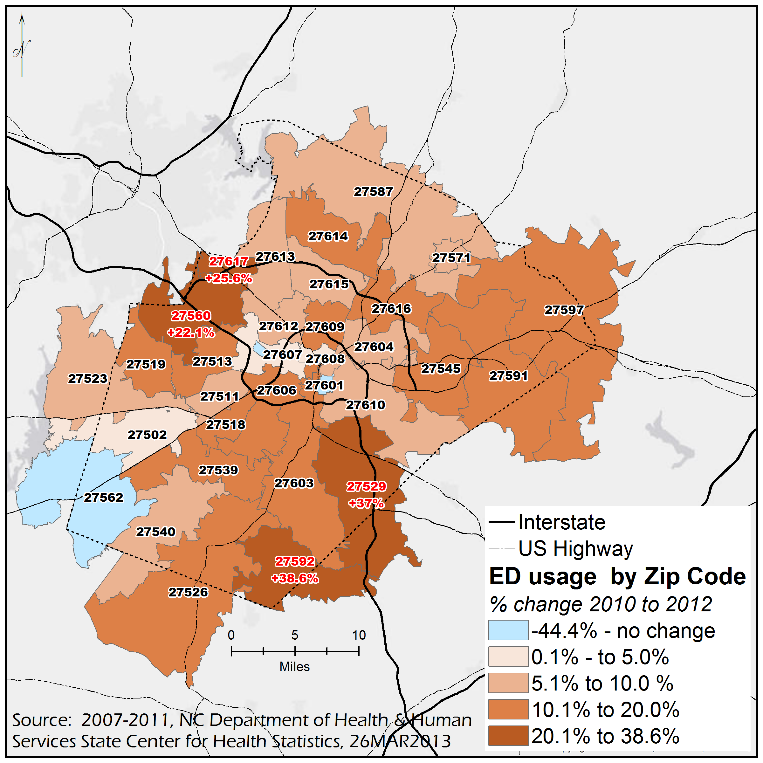
This source discusses how the percentage of emergency department visits change from 2010 to 2012 via zip code. This data was created via Wake County’s (North Carolina) Community Health Needs Assessment (CHNA). This visualization allows for public health officials to understand where need is within the community, and implement proper interventions.
Source: https://sph.unc.edu/nciph/gis/
5: GEOG291 Quiz was completed.