I have completed the GEOG 292 Quiz for Week 1
Hello! My name is Payton Beard, and I am a junior from Cincinnati, Ohio. I am a zoology major with a chemistry and ENVS minor, hoping to either work at a zoo or become a vet. I chose to take this class, as it seemed like something interesting that also followed along with my ENVS minor. Outside of class I am a part of the soccer and softball team, so I am always busy.
While looking around the ArcGIS Online page, we could see all my past projects, which is cool, but you are also able to go into the gallery and see other projects that have been posted, which is also cool. Another cool thing is that there are a lot of links to places that can help people become better at using ArcGIS Online.
One thing that is cool about ArcGIS Online is that a lot of people can use this app for the different jobs they do. You can use this for governmental jobs, business things, science things, or even just for everyday things.
Another thing that is cool about ArcGIS Online is that it was very useful during COVID, as it was used as a tracker of the pandemic and how it was spread all around the world.

The tutorial for the ESRI was very helpful. It showed how to use the instant apps exactly. It gives a really great in depth preview of the apps and what each one is for and exactly how to use it. The other thing that was interesting was the difference between public and private sharing options. This can be important in many ways if you are working on something just for yourself, or working on it for your boss, or working on something that you want others to add to even if you don’t know them.
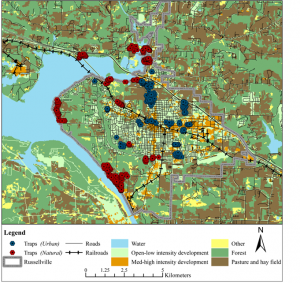
For the topic I decided to look at is at trapping locations for domestic cats in Arkansas. We can see from this map that the red symbols are traps in natural areas, and the blue symbols are traps in urban areas. We can also see other important features on these maps like developed area, forests, pastures and hay fields, and water. From this map we can see researchers used 38 trapping locations (23 in developed areas, and 15 in natural areas. This research is really good to seethe populations of feral cats in a certain area, and if their actions all are the same in 2 different types of land.