Week 1
Hi all, my name is Luke, and I am a Junior ENVS Major here at OWU. Having already taken the 291 course, I was already familiar with the layout of the class page and website. I did, however, go into the settings and change the theme to “coffee”, which I thought looked nice, and also added a short biography to my profile.
While reading through the “Get Started” article, one thing that stood out to me about ArcGIS Online was how much easier it is to share maps and data with the Online version compared to the Pro version. Being able to collaborate and share information seems like a very useful aspect of ArcGIS Online. Another aspect I read about in this article was that ArcGIS Online is also available on iPhones and tablets, which seems like another very useful feature. Overall, ArcGIS Online appears to be a more accessible software, with more emphasis on collaboration and sharing than the Pro version.
In the ArcGIS Online Basics training course, I learned about the sharing capabilities within the software, such as the private, group, organization, and public sharing options. These options allow users to limit access to maps that might be private and share them with their desired audience. I also learned about the different types of layers, such as features, tiles, and map images, and how to identify whether a layer is a basemap layer or an operational layer.
Two courses I found that might be interesting to complete were the “Forest-Based Classification and Regression Analysis Using ArcGIS Pro” and “Analyze Imagery with Raster Functions Using ArcGIS Online.”
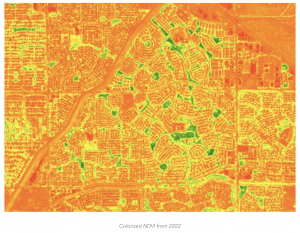
One article I read came from the ArcGIS blog and explained how mapping can be used to display urbanization patterns and the expansion of urban areas. This can be done in a variety of ways, but the most common is measuring green space within an area and calculating NDVI, as shown in the image below.
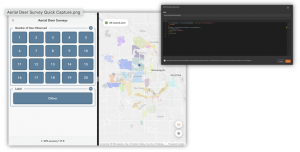
Another study I found interesting came from a parks district in my home state of Minnesota, which used aerial drone imaging to take pictures of deer, then used ArcOnline to create deer zones to better understand local deer populations.
Week 2
Chapter 1 emphasizes the sharing capabilities of ArcOnline and how it can be used at any level of experience with GIS mapping. In short, the online version makes GIS more available to everyone, allowing GIS users to share information with peers in other professions and the general public. Content types were also highlighted in this chapter, such as data, layers, web maps, scenes, tools, and apps. It also explains the difference between basemaps and operational layers, in which basemaps provide reference or context, and operational layers can be edited by users for whatever purpose they need. I also learned about the difference between hosted and non-hosted feature layers, where hosted layers use data stored within the ArcGIS software, and non-hosted data comes from outside sources that a user or organization uploads. Attachments can also be uploaded to Arc and used to include more information or a visualization of a location on a map.
The Chapter 1 tutorial showed how to create a map, upload imagery and files, and do basic edits to it, such as editing data within a point. It also explained how to share a completed map and how to create a web app from a web map.
Chapter 2 dives deeper into the many types of layers and how to publish them. It also introduces the concept of smart mapping, which allows users to style their layers so that their maps display an intended purpose. Some examples of this are heat, color, and size, relationship, dot density, and type and size map styles. Pop-ups can also be useful for creating a more detailed map. When a location is clicked, a default pop-up shows the list of attributes and values for that location. Users can also add images, charts, and other external data to pop-ups to create a more interactive map. This chapter also highlights the different ways that users can explore and preview maps, such as map tour blocks and slideshows.
The chapter 2 tutorial showed how to edit layers using the styles pane, and how data can be displayed in a way that is visually appealing and makes sense. Using storymaps was a little complicated with how many options there were to add different types of text, images and animations. I found the express maps to be useful in creating a quick and simple visual.
One application I thought of was to use data from colleges and universities to visualize changes in student enrollment over a period of time. This could be used to see trends in the preferences of college students when selecting schools, which could be used by schools to make changes to meet their enrollment goals. This could also be further developed into a web app that allows prospective students to suggest where they should go to college, based on how their interests and educational needs line up with those of students currently attending those schools.