I am Claire Evans, a second year Environmental Science major and Art History minor. I took GEOG 291 last quarter.
I created my account for accessing the Community page and found that the link to ArcGIS Blog leads to a 404. The Help page seems like it will be helpful if I forget something basic from the first course and want to re-learn it.
The Notebooks creation seems interesting, though I don’t know any Python so I doubt I’ll use it. I’ve learned that a floor-aware map is a map that shows different levels of a building, such as the polygon of the general building shape and the floor plan inside. I’m interested in architecture, so this seems like a fun tool to play with.
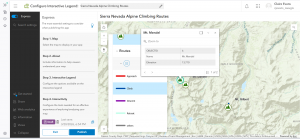

It’s interesting that you must turn off searching only within the organization; it’s useful if you are working with organization specific data but less helpful when learning the program. When I accidentally clicked out of the course, it made me start from the beginning again, so that’s something I’ll have to keep in mind.
Integrating CAD data with ArcGIS seems neat to me because I remember thinking that the CAD integration in GEOG 291 was cool. The Systems Approach to ArcGIS: Architecture Pillars sounds cool too because I like architecture. Python 101 for AcrGIS could be a useful course, since I don’t have any coding experience and it could make me a more competitive job applicant.
Applications of ArcGIS:
Using GIS and Open Web Resources the Reconstruct Great Tang Records of the Western Regions
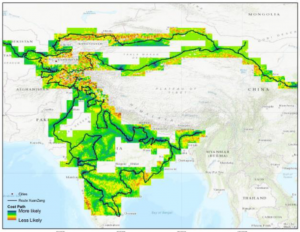
This paper uses ArcGIS and the biography of Buddhist pilgrim XuanZang to map the locations of many city states and monasteries and uses topographical information to see what routes he likely took between them based on what would require the least amount of climbing mountains or particularly rough terrain.
Generation of a Multi-Scale Historic BIM-GIS with Digital Recording Tools and Geospatial Information
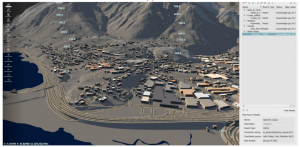
This project used ArcGIS and BIM to 3D model a historic Romanesque town in Italy for UNESCO information and further analysis, since it was difficult to properly model the town using more basic tools due to the large size of the land area and the unusual features of the buildings.