Massaro Final

For my final, I created two Web Apps.

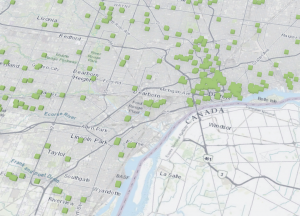
This first web app was created using Experience Builder. It displays different dog parks in the Columbus area and their ratings. In the app, you can view a pop-up menu that displays the locations. You can click on the locations to zoom into them. You can also filter out lower-rated dog park locations.

https://experience.arcgis.com/experience/9dbde9cde76a421ea6fb2002cc3bb57e

The second web app I created was through Instant Apps. I this app, you can see wildfires displayed throughout the US. You can search for specific locations on the map. In addition to this, using the swipe feature, you can view areas that are critical habitats for endangered species. You can use the swipe feature to compare the wildfires and the habitat locations to determine how the fires could be impacting endangered species populations.

https://owugis.maps.arcgis.com/apps/instant/basic/index.html?appid=3cca7e943ff0444d963574bb47f6d034

Duncan- Week 5

Chapter 7: This chapter is all about 3D web scenes. This is something that really interests me as 3D models are particularly exciting to me. As the book says, we do live in a 3D world so being able to map things in 3D is crucial to fully understanding an area. This chapter teaches us the basics of 3D GIS, it also explains the benefits that we gain from making our maps 3D as we have more accurate details, and more intuitive analysis of the maps we make. With 3D maps you get a new facet of the maps, we have always had features and textures, but with 3D GIS we also have atmospheric effects. Which would be things like fog and cloud cover, as well as certain types of lighting effects. Scene layers allow you to visualize complex digital models and it allows you to interact with the buildings are have those layers applied, which in my eyes is really cool.  A 3D building scene is another thing this chapter explains as it gives us the steps and the structure to follow. those steps include an overview, this is the layer that allows you to view a 3D building as a single layer, and it can be created by an exterior shell which would be made by using the building layer. Then, you have discipline, which combines the category layers into various disciplines off a building. Then you have Category layers, which represent individual categories. followed by Filter, which allows you to view details in complex buildings and you can choose to only show certain elements of the attributes selected. Then you have the integrated mesh scene layers, which are constructed by large sets of overlapping imagery. After that you have the point cloud scene layers which are described as the layers that provide a fast display of large volumes of symbolized point cloud data. Then theres the point scene layers whih are used to ensure a fast visualization in all clients and they use a cached point scene layers used to display large amounts of point data. Finally you have voxel scene layers, which are the layers that represent multidimensional, spatial, and temporal information.

Potential Application- Making a 3D landscape of buildings within the Delaware area and how long they have been there.

Conti – Week 5

Chapter 7 is about 3D scenes and how this is accomplished via extended reality systems such as VR, AR, and MR. Maps that use 3D scenes can be realistic or cartographic. 3D scenes have a few main elements including surfaces, features, textures, and atmospheric effects. 3D scenes can also have textured or untextured layers to visualize complex digital models which typically has an overview, discipline, category layer, filter, integrated mesh scene layer, point cloud scene layers, point scene layers, and volex scene layers. This technology can be used for many things such as building metaverses and urban planning.

Conti – Week 4

Chapter 5 focuses on ArcGIS Enterprise and specifically on-premesis Web GIS. People may choose to use ArcGIS Enterprise instead of ArcGIS Online because Enterprise runs on user-managed infrastructures and is typically used if on-premesis GIS, hybrid GIS, or functionalities only available on ArcGIS Enterprise are needed. ArcGIS Enterprise includes a portal for ArcGIS, an ArcGIS server, ArcGIS web adaptor, and an ArcGIS data store. All of these aspects work together to create effective software.


Chapter 6 is all about spatiotemporal data and real time GIS. Spatiotemporal data is categorized as moving, discrete, stationary, or change. This is important to real time GIS because it is a way to provide better situational awareness, enhance emergency response, and support better decision making. This chapter also talks about the Internet of Things (IoT) which is the network of physical objects embedded with sensors and network connectivity that allow the physical objects to collect and exchange data. This data can be understood as intelligence which, with geolocation context, can be acted on. The IoT can be applied as a smart city or a smart home. Chapter 6 also discusses ArcGIS Velocity and ArcGIS GeoEvent Server. Both softwares interact with various data sources and translate different data formats, filters and analyzes data in real time, and sends processed data to external sources.

Conti – Week 3

Chapter 3 focuses on ArcGIS experience builder which allows a person to create experiences on the web using a flexible layout, content, and widgets that interact with different kinds of data (both 2D and 3D). Widgets come in two types: Basic Widgets and Layout Widgets. Basic widgets function as app tools, while Layout widgets are containers that help organize other widgets on a person’s pages or windows. Widgets are also able to talk with each other using message actions or data actions. Message actions perform automatically when given a trigger, while data actions need the user to tell it what to do. Message actions are made up of the triggers, the targets, and the actions which can all work together to create dynamic content.


Chapter 4 is all about mobile GIS which is GIS on mobile devices. Mobile GIS has some advantages such as a large volume of users, mobility, versatile means of communication, ease of data collection, location awareness, and near real time information. There are also some disadvantages that come with the use of mobile devices such as limited memory, limited CPU speed, bandwidth and network connection, screen size, keyboard size, and battery power of the mobile device. There are different types of ways a person can develop apps on a mobile device including the browser based approach, native based approach, or the hybrid based approach. Browser based is less costly and generally more accessible, but does not always perform well, while native based is more expensive, requires more knowledge of mobile software, but generally performs much better. Hybrid based is a mix of both browser and native. This chapter also discusses ArcGIS Fieldmaps which is a combination of many other ArcGIS products and can be used to help plan, track, and understand data as well as help with the process of capturing data of field workflow. Fieldmaps can utilize many different apps and technologies such as AR and VR in its creation of an interactive map.

Conti – Week 2

Chapter 1 functions to introduce ArcGIS online and the basic ways to use ArcGIS Enterprise. This system allows people to use the web in order to access information concerning almost anything. This system makes information instantly available for people from anywhere in the world. Web GIS is low cost, simple maintenance, easy to use, and good cross-platform capabilities. The different content layers of WebGIS include web maps and scenes, data layers, tools, and maps. The three layers of creating a WebGIS map are basemaps, operational layers, and tools.

Chapter 2 focuses on mapping and storytelling The chapter delves into different hosted layers including tile layers, feature layers, WFS layers, hosted WMTS layers, and many others. The chapter discusses the many different ways to publish a layer such as creating the layer from a template, creating it from your own data, and creating a layer in which you define your own fields. The chapter also talks about smart mapping. This is a process that allows people to create, share, and analyze maps quickly. Analyzing the map could show patterns that a person might not have been able to catch themselves. The chapter lays out the traits of successful storytelling with ArcGIS and mapping. A successful story tells who, what, when, where, why, and uses multiple forms of media to tell a story. Making maps visually appealing and interactive in this way not only to make a map look pretty, but also to make the map easier to understand and analyze.

Saeler week 2

Chapter 1

  • This chapter introduces basic concepts and workflows of web gis and the esri geospatial cloud. Beginning with an overview of web gis and lists the technical evolutions in web gis and explains its content types, hosted feature layers, app types, and user types in web gis. Then going onto demonstrate the workflow to build web gis apps using the attachment viewer instant app template.
  • Starting with publishing a hosted feature layer from a csv file and adding attachmetns; to adding a field to the layer and editting the attributes; then creating a web map; and finishing with creating an instant web app using a template.

Chapter 2

  • web layers are important because they are the building blocks of web apps which are important because they are the faces of web gis. Stories being more popular. Continuing the discussion of feature layers and web apps particularly arc gis webmaps. This chapter introduces feature layers and the various ways you may style them using smart mapping and discussing living atlas of the world. as well as further exploring storytelling using gis.
  • Tutorial- starting with creating a feature layer using geocoding, then configuring layer style using smart mapping, proceeding to configure layer popups using gis arcade, then adding images and charts to layer popups, finishing up with creating a story and working with swipe blocks and express maps.

Hess – Week 5

Chapter 7:

Chapter 7 focusses heavily on 3D mapping and web scenes. Some of the main takeaways include gaining a general understanding of what web scenes are and the terminology associated with them, learning about different scene layers ad the features used to build them, and creating web scenes with tools like Scene Viewer. The chapter Aldo covers concepts such as 3D visualization, the metaverse, AEC (Architecture, Engineering, and Construction), and the broader value of GIS, as well as how to create and use feature layer that contain z-values. Overall, these topics provide a solid foundation for understanding how 3D maps work, which is more complex than creating standard 2D maps.

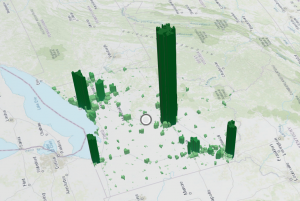
My application for this is making a map of mosquito West Nile virus cases in Ohio by county, but having the counties rise up (z plane) base on the amount of cases.

Hess – Week 4

Chapter 5:

This chapter focuses on the Hybrid GIS system, a hybrid GIS system combines multiple deployment models; desktop, web, and cloud GIS, and integrates the strongest features of each. The chapter also covers raster and vector tiles. Raster tiles divide a map into image segments that’s can be reassembled after being transmitted, while vector tiles package geographic features into grouped vector data files, often delivered in the Protocol buffer Binary Format (PBF).

Chapter 6:

This chapter explains spatiotemporal data and real-time GIS. Spatiotemporal data comes from many sources, ranging from manually collected data to information gathered from sensors or generated by models. Real-time GIS involves data that is captured and processed either at a single moment or continuously over a period of time. Spatiotemporal data falls into 4 categories: moving, discrete, stationary, and change-based. The chapter also introduces the internet of things (IoT), describing it as a network of everyday physical objects equipped with sensors and connectivity that allow them to collect and exchange data. Examples include taxis, bicycles, refrigerators, biochips, and security cameras. Today, IoT consists of billions of sensors, and its overall market value is much more than we can estimate it to be.

My potential application of these concepts would be a GIS baes Census for all of Pennsylvania to track Elk Populations as they start to move back into Pennsylvania.

Asp – Week 5

Chapter 7 introduced me to 3D visualization and how it can transform spatial data into immersive and interactive environments. I was very interested in how scene viewer allows users to convert basic 2D GIS data into 3D scenes with points, many types of polygons, in the sky and undergound features. Chapter 7 made it very clear to me that 3D GIS doesn’t only just make maps look more appealing but it also helps people explain spatial relationships such as underground utilites, building heights, sunlight and shadow changes throughout the day. 

One of the most interesting parts of the reading to me was when it talked about VR, XR and also MR technologies how these overlap in the theory of the metaverse. The idea that GIS data can help construct real looking 3D worlds whether it’s for gaming, urban planning or emergency training this shows how geography and virtual design are becoming more secure than ever. I also thought the ArcGIS indoors and ArcGIS urban was very cool. Having these tools to use for 3D mapping can help us go beyond just outdoor areas and shift into interior spaces and city planning. 

Application: Using the information from chapter 7 I could create a 3D web scene of the Ohio Wesleyan University campus. I tried to make my map look good but this was the best I could do unfortunately. My map isn’t good at all compared to others but I added different types of  trees to the campus of OWU.