Chapter 5: This chapter goes over the intricacies of ArcGIS Enterprise, which to my understanding is a form of ArcGIS online. It includes data from the Esri cloud, with the difference being that Enterprise is a locally managed app/databank to be used by members of an organization. It has a wide variety of apps and features that can be implemented, such as ArcGIS Servers, ArcGIS Web Adaptor, ArcGIS Data Store, etc. This chapter also goes over the different web layer types that can be created in ArcGIS Online and ArcGIS Enterprise, such as raster tile layers that are created from image files, vector tile layers that are more customizable and use the PBF file format, and map image layers that can be drawn by the server or by using files from a cache.
Chapter 6: This chapter is about spatiotemporal data, which includes things like moving data points that can be used for EMS purposes (tracking ambulances, fire engines, squad cars), and fixed data points like crimes, points of interest, and car crashes. The chapter also covers real-time GIS which covers continuous data points which change over time. Examples of this are temperature, wind speed, and precipitation. An interesting topic in this chapter is IoT, or Internet of Things. This refers to the modern phenomenon where a lot of the things we use to live our day-to-day lives are capable of sensing conditions and communicating with one-another. A good example of this are smart cars that are capable of self driving. These cars use the IoT in tandem with built-in sensors and computers to calculate their own position as well as the position of things around them, even in conditions that humans would not be able to see well in. It was also interesting to do the tutorials for this chapter and see that the map was updating in real time.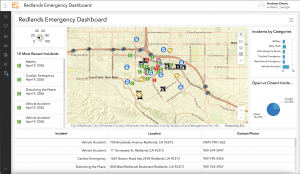
An application for chapter 6’s information could be used on trail maps to report things like trail obstructions, hazardous conditions, and sightings of dangerous wildlife. Trail cams could be used along with hiker reports to create a map for the trail that could be used by park rangers.