
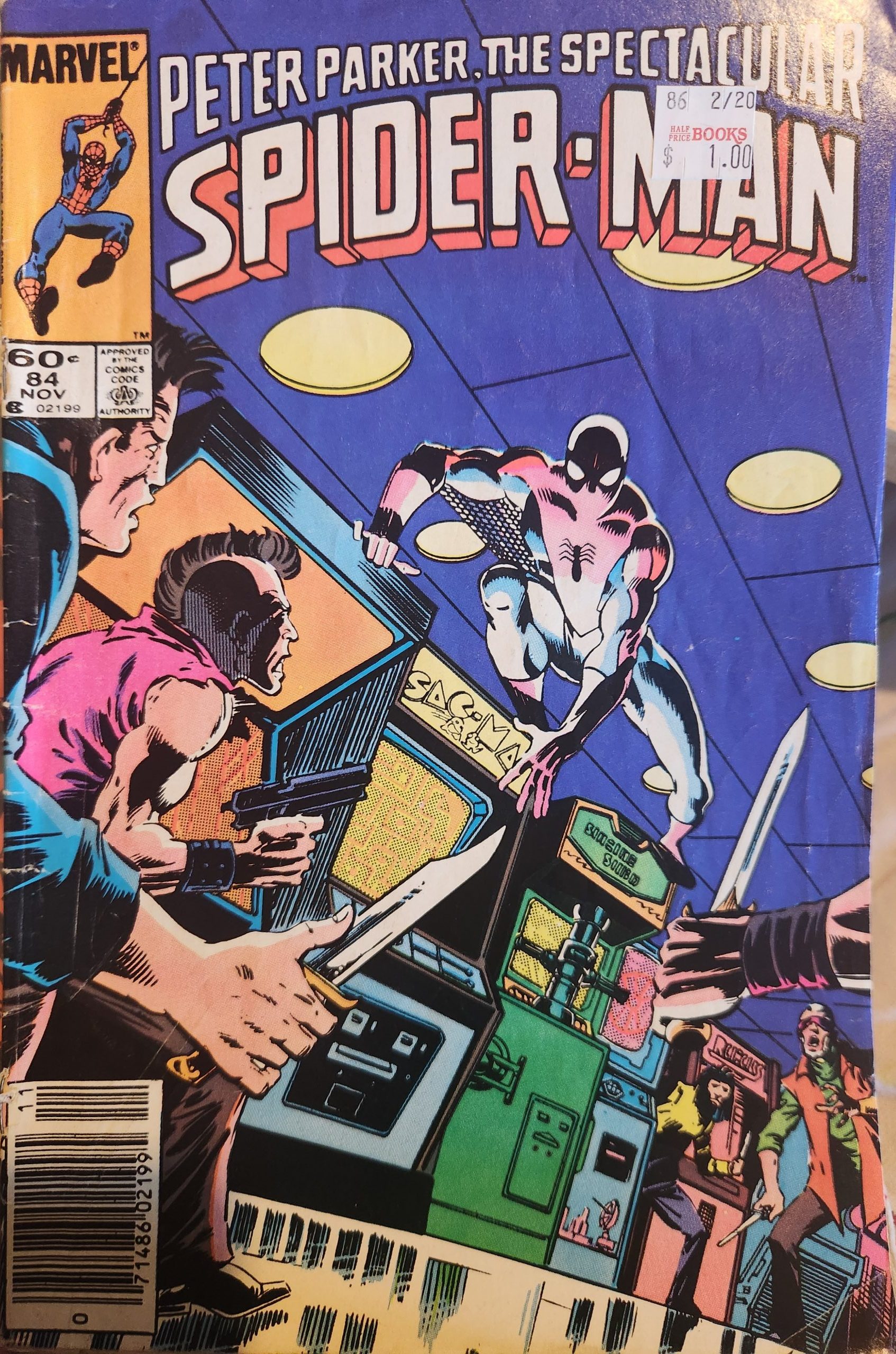
In part two of our exploration of the Bronze Age of comics (1970-1985) we will be focusing on how some comics were promoted as a mechanism to speak to kids and young adults about the dangers of smoking, and to comment on poverty and inequities in America. During this era, the Comic Code Authority (CCA) was becoming more relaxed on many of its restrictions and censorship that stemmed from the Silver Age. Comics were free to explore darker themes, and real-life issues such as racism, poverty, pollution, drug abuse, etc. (“Explaining The Gold, Silver, Bronze And Modern Ages Of Comics.” 2025. The Comic Book Sanctum).
Marvel Comics Group, “Spiderman, Storm, and Powerman: Battle Smokescreen,” 1982.
I want to return for a moment to “Spiderman, Storm, and Powerman: Battle Smokescreen.” In this comic, Smokescreen is a villain that personifies the dangers of smoking which is the main focus of this story. Spiderman, Storm, and Black Lightning work together to keep a star athlete away from a gang of drug dealers who are supplying the athlete with a hangout spot and cigars to smoke which make his body weaker. The superheroes successful efforts in combatting these threats to the athlete’s social and mental health, thus helping him turn his back on smoking and hanging out with criminals is a simple metaphor for young people and kids to resist peer pressure to smoke, and instead strive to live a healthy, safe life.
Kupperberg, Paul. “Oil, Oil…Nowhere!” The Brave and the Bold: Batman and Black Lightning. DC Comics, 1980.
Next, returning to Black Lightning’s appearance in “Oil, Oil…Nowhere!” Black Lightning is shown going to his apartment in “Metropolis’ Notorious Suicide Slum.” Even though Black Lightning (Jefferson Pierce) has fantastical strength and agility, he continues to live in the dangerous and impoverished neighborhood where he grew up. He chooses to face the constant threat of violence in his own neighborhood in order to protect the other Black people subjected to poverty and poor living conditions in the city, due to very real economic and racial disparities that persist today. It is important to note that juxtaposing Blackness with problems such as drugs, smoking, poverty, and criminal violence is problematic, but I feel that many of the depictions of these problems are done in a way to help uplift Black people, rather than degrade them with stereotypes as Black superheroes are fighting against these issues. The nod to the economic and social disparities that many Black people have and still face today alongside this powerful Black superhero works to make Black people living in poverty feel seen and to recognize their struggle.
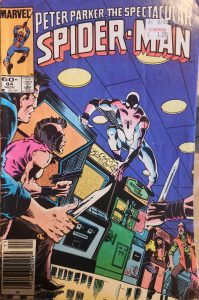
Mantlo, Bill. “My Baby’s Been Kidnapped!” Peter Parker, the Spectacular Spiderman, Marvel Comics Group. 1983.
In many issues of Spiderman from the 1980’s you will see Spidey up against gang members as many of his fights are at street level. In the issue “My Baby’s Been Kidnapped!”, the main antagonists are a corrupt politician, and gang members who are contributing to this corruption because of their own desire for money. To be more specific, in this issue a councilman exploits the kidnapping of his own infant son for media attention, and to bolster his family image. A Hispanic woman living in an impoverished area of the city takes the baby to prove to herself that she can be a good mother after her last child died of an illness. Further, the windows of the women’s apartment are boarded up with X’s spray painted on them, trash clutters the streets and the steps to the entrance of the apartment, and lightbulbs dangle from cables on the ceiling. Gang members that seem to live in the woman’s neighborhood notice she has the missing baby, and break into the woman’s home to take the baby for a reward. Spiderman also attempts to question and ends up having to fight gang members hanging out at an arcade. After the baby is stolen by one of the men in the neighborhood, Spiderman pursues the man down an alley where he fights off six stray, bloodthirsty dogs to protect the baby and the man who stole him. Finally, Spiderman returns the unharmed baby to the councilman and his wife.
This comic sheds light on gang violence and poverty in juxtaposition with wealthy, corrupt politicians effectively. Poverty is represented by the worn down neighborhood in a way that does not seem too offensive or condescending. Spiderman defeats the gang members to show youth that gang violence is immoral. However, Spiderman also protects the criminals even though they kidnapped the baby, which shows young readers that the lives of criminals are still just as valuable as those of innocent persons as we are all human and can make mistakes.
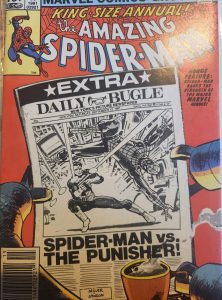
O’Neil, Dennis. “Spiderman: Threat or Menace?” The Amazing Spiderman. Marvel Comics. 1981.
The Punisher is a symbol of violence and inequality in society, the faults of the justice system, and the ethical dilemma of dealing with these problems in a way that allows proper justice. He makes some appearances in conflict with Spiderman. The Punisher also known as Frank Castle is an antihero. He is not completely a hero nor a villain as he fights for morally just causes but he kills bad people who hurt innocent lives, instead of detaining the criminals and putting them in jail. Sometimes the Punisher fights domestic terrorists, murderers, drug traffickers, etc. In The Amazing Spiderman: “Spiderman: Threat or Menace?” The Punisher attempts to evade Spiderman and the police after shooting and killing a “guru,” or spiritual teacher of Hinduism, who takes advantage of his desperate clients seeking his advice. The actions of the Punisher makes us ask, is there a level of violence that can be justified? And why are there so many acts of violence being committed today, especially mass shootings, domestic terroism, and political violence?
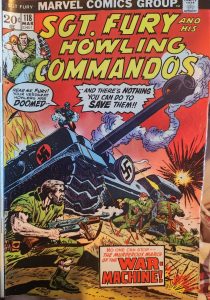
Conway, Gerry. “The War Machine.” Sgt. Fury and His Howling Commandos! Marvel Comics. 1973.
One final comic that I wanted to mention which I believe effectively speaks out about societal problems is this issue of Sgt. Fury and His Howling Commandos, where they are fighting Nazi Field Marshal Erwin Rommel or “Desert Fox,” his men, and tanks. This comic goes back in time to WW2 where Fury is fighting against one of the most extreme and vile symbols of racism—the Nazis. The act of Fury and his team fighting and defeating Nazis clearly combats racism and hate in a way that can reach and inform young people. This also promotes the American ideals of freedom and justice, and further bolsters sentiment and pride for the American armed forces.
i remember when i was about 10 or 11 years, my father have little shop in our homeland, i forget the name of product soap, but i really remmember each box have free comic superman, iam so exciting, thnak you for this post