
I have been collecting and reading comics for over five years now. This hobby was something that I would not usually tell people because of the negative perception I assumed would come from being a “comic book nerd.” I enjoy many vintage things such as books, music, and movies. I have, like many other people still today, a sort of nostalgia for a time that I have never experienced. My feelings about comics are further complicated due to the racial dynamics of the past compared to now, and how comics reflect that. I frankly have never completely felt that I was a part of the target audience for comic books but I read them anyway. However, seeing Black superheroes in comics definitely makes me feel a bit more included and welcome to enjoy comics too. Due to these complexities, I myself have wondered exactly why I enjoy comic books so much, particularly, vintage superhero comics, and why I couldn’t stop going into Half Price Books every now and then to buy a few cheap comics. But reflecting on the many aspects of comic books that I enjoy, it starts to make sense.
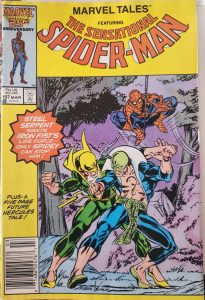
Claremont, Chris. “Night of the Dragon,” The Sensational Spiderman. Marvel Comics, 1971.
I have this one memory that stands out in my mind of me sitting on my front porch some summers ago listening to “I Can Hear Music” by the Beach Boys, and I was reading one of the first comics that I bought titled, “Night of the Dragon” from the series The Sensational Spiderman (featuring Steel Serpent and Iron Fist). Just recalling this memory fills me with joy. I was so enthralled by this comic of my favorite superhero Spiderman, looking at the bright colorful images, and even seeing a Black female superhero (Misty Knight). Her appearance in this comic was a great surprise as she was not on the cover, but I will come back to this later.
There are four categories for the different time periods of comics: The Golden Age of the 1930s-1950s, the Silver Age of the 1950s-1970s, the Bronze Age of the 1970s-1980s, and the Modern Age which spans from the 1980s up to present day. My favorite comic books are from the Bronze Age which saw darker themes, and a scaling back of Comic Code Authority regulations so that comics could explore and criticize more serious and real-life issues (“Explaining The Gold, Silver, Bronze And Modern Ages Of Comics.” 2025. The Comic Book Sanctum). Also during this time period, many established comic book writers were being replaced with new, younger writers (“What Are The Different Comic Book Ages?” Sparkle City Comics). In this four-part series I want to discuss what I love about the superhero comic books of the Bronze Age which include: a continuation of Black representation in comic books; the utilization of the comic book as a mechanism to speak to young people about the dangers of drugs, smoking, and to shed light on the issue of poverty in America; the philosophical and mythological influences in superhero comics; and the beauty of the comic book art of the time. Today we will just focus on Black representation in Bronze Age comics.
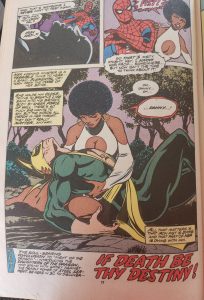
Misty Knight in “Night of the Dragon.”
“Night of the Dragon” follows Spiderman’s ally Iron Fist, also known as Daniel Rand-K’ai, who is a professional martial artist that has been neglecting his craft. Steel Serpent is Iron Fist’s former friend turned arch enemy who has supernatural skills in martial arts, and wants to drain Iron Fist’s life force and martial arts abilities or “Chi” from his body. Spiderman and Mercedes “Misty” Knight interfere in the formal challenge between Iron Fist and Steel Serpent to try to save Iron Fist’s life. There is some Black representation in “Night of the Dragon.” Misty Knight, who is Iron Fist’s lover, dons an afro, a sleek white dress, and a laser gun. She also has a bionic right arm to surprise unsuspecting bad guys! I must admit, however, that it does bother me slightly that Misty Knight, the only black woman in this comic, is not included on the cover. But this made her appearance, however brief, all the more shocking and exciting to me as a Black girl who was just starting to read some old comics.
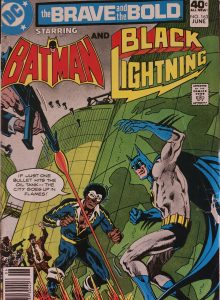
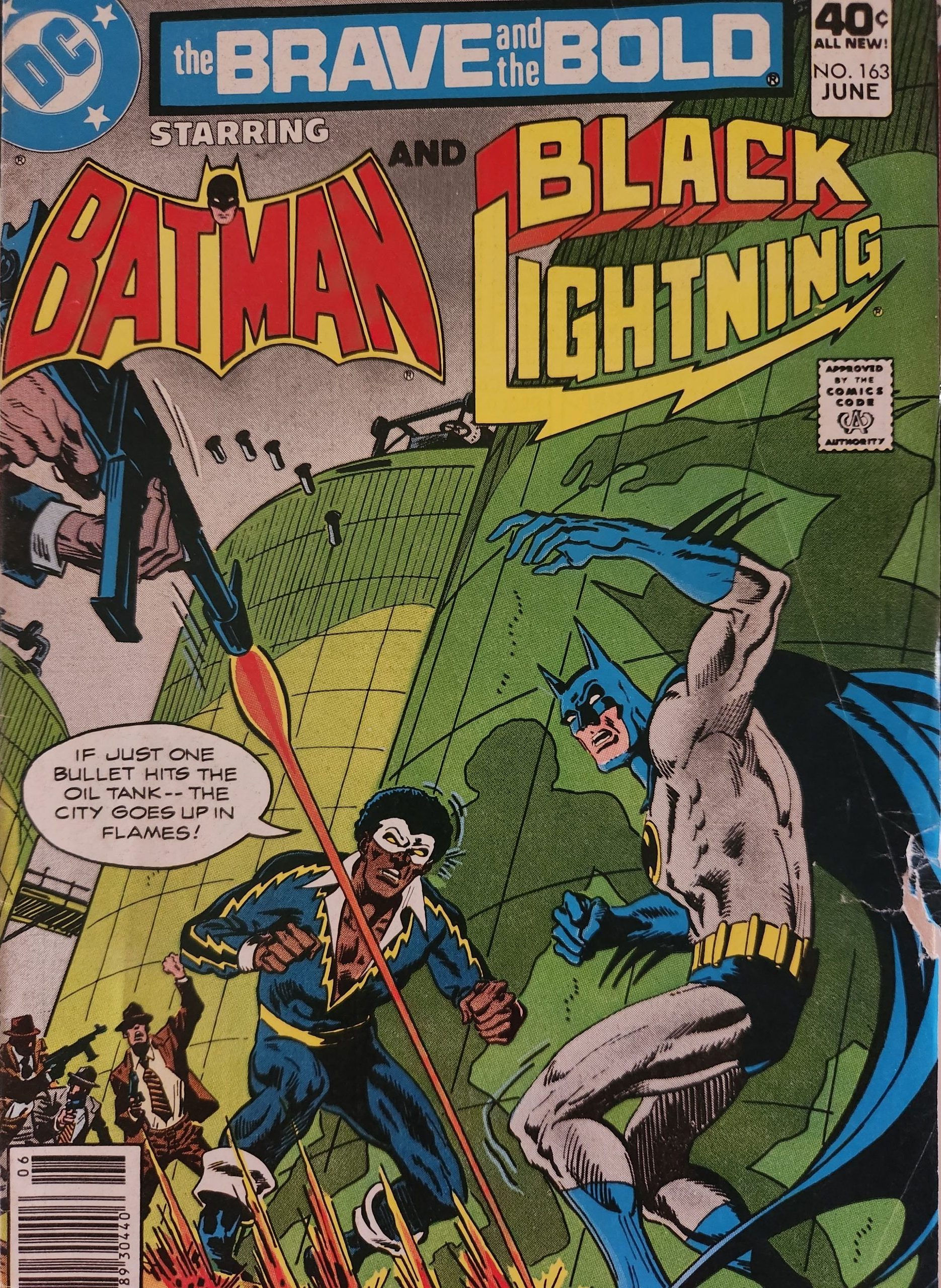
Kupperberg, Paul. “Oil, Oil…Nowhere!” The Brave and the Bold: Batman and Black Lightning. DC Comics, 1980.
Black Lightning makes an appearance as a sidekick to Batman in “Oil, Oil…Nowhere.” Batman and Black Lightning attempt to prevent a gasoline hijacking in Gotham. It was amazing to see a Black male superhero fight alongside the iconic Batman. Batman appears to trust Black Lighting as a fellow crime fighter as much as he does Robin, which I think makes a powerful statement on diversity and equality even though these characters are fictitious. Black Lightning (Jefferson Pierce) is a school teacher, and under his alter ego of Black Lightning has great strength and fighting ability, fighting side-by-side here with billionaire crime-fighter Bruce Wayne as Batman.
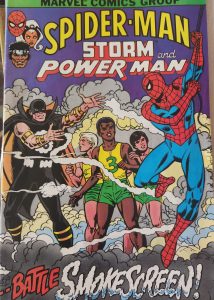
Marvel Comics Group, “Spiderman, Storm, and Powerman: Battle Smokescreen,” 1982.
Two more amazing Black superheroes team up with Spiderman in “Spiderman, Storm, and Powerman: Battle Smokescreen.” Storm is a mutant at birth with the ability to control the weather and fly. Power man (Luke Cage) is a coach for high school track athletes. He received super strength after a secret experiment. These three superheroes work together to fight Smokescreen (a villain with the ability to emanate clouds of smoke from his hands), in order to ensure that a star athlete, who is a young Black man, can succeed at his track meet and not succumb to the dangers of smoking.
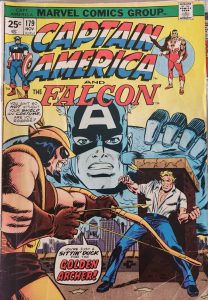
Englehart, Steve. “Slings and Arrows!” Captain America and the Falcon. Marvel Comics, 1974.
One last comic book series that I wanted to highlight for its inclusion of Black superheroes is Captain America and The Falcon. In this issue, Captain America (Steve Rogers) is trying to stop a villain named the Golden Archer from killing him in his vulnerable state of being Steve Rogers without his usual shield and costume. While the Falcon (Sam Wilson), currently ex-crime fighting partner of Cap goes out alone to confront a Harlem crime boss. The Falcon, a U.S. Air-Force veteran and paratrooper has an empathic bond with his falcon Redwing, he also wears a high-tech suit which allows him to fly. Unfortunately, the Falcon’s appearance in this particular comic book is brief as the main focus is on Captain America regaining his desire to be Captain America again after a brief stint hiding in the shadows as Steve Rogers. Nevertheless, this sub-series of the two heroes both being represented as symbols for American values is powerful, and is a mechanism to combat feelings of alienation and unbelonging that Black American comic book readers may feel.