
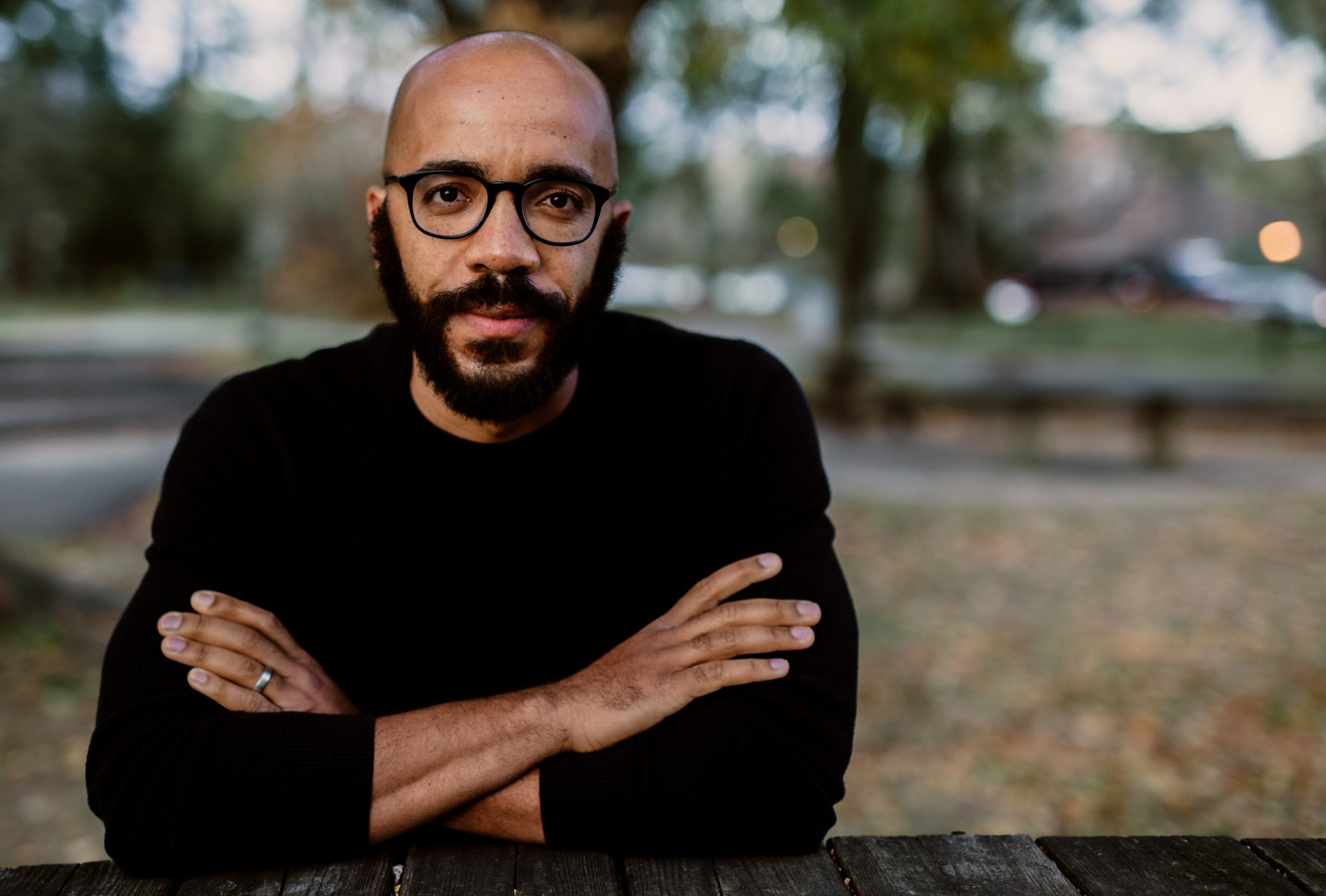
On Tuesday, October 14, the English department was delighted to host Clint Smith as our speaker for the Carpenter Lecture this year. Smith is a nonfiction writer, poet and journalist. Smith discussed his travelogue How the Word is Passed that was published in 2021. He also read a couple of poems from his most recent poetry collection titled Above Ground which was published in 2023. Smith’s works focus on Black history, slavery, prison education, and family life.
Smith was born and raised in New Orleans. He was displaced by Hurricane Katrina during his senior year of high school. Smith went on to study English at Davidson College in North Carolina where he was introduced to the world of slam poetry. He lived in South Africa for a year where he was captivated by the literary culture of Johannesburg. He became a high school English teacher, earned an interdisciplinary PhD at Harvard University, and has also taught incarcerated people. In 2016, Smith published his first poetry collection Counting Descent, and worked as a freelance writer. Later, Smith became a staff writer at The Atlantic, he published his book How the Word is Passed (which was motivated by the removal of many confederate statues that began in 2017), he further collaborated on a series of Youtube videos about Black History with the Youtube channel CrashCourse.
Smith’s How the World is Passed follows the author as he travels to places such as Louisiana, Monticello, Texas, New York, and outside of America to Goree Island in Senegal to discover how they view and tell their stories of the history of slavery in America. Smith claims that he writes “from the opposite of expertise,” and through the act of writing he teaches himself about the subject he is writing on. So in this book, Smith pushes himself to go to uncomfortable, new places such as a confederate cemetery; and the Angola Prison, the largest prison in America which was built on the land of a former plantation in order to learn the truth about what really occurred there, to experience what these places look and feel like, and to learn how this history ties to what has been done to Black communities. Smith talks to the people in these places to gauge the extent to which the narratives about slavery in America that they were taught differs from the truth, and how much these narratives compose one’s identity. Smith acknowledges the problem of most people not wanting to admit that they are wrong about something, especially about their beliefs. He notes that if people discover they were wrong about the story of America, then they must come to terms with the likelihood that the story of themselves is different then they thought. It seems reasonable, and good to have pride in one’s country but it’s nothing short of scary how many lies about America’s history of racism have been promoted and accepted by many Americans, and how dependent many Americans’ sense of identity are upon their ideas of their country’s values and history. Nevertheless, Smith points out the need to still confront institutions and people that continue to promote racial stereotypes and false narratives, but implores the importance of not alienating the person(s) you are in conversation with.
Smith has recently returned to poetry. He notes that he began his writing life as a poet and that poetry can “animate your way of thinking.” In addition, he believes that poetry can help track the ever-changing world and your own “sense of self” as it forces you to stop and analyze the world, and describe it through phenomenological devices that point to the readers’ senses. A poem of his that he read during his lecture is titled “Your National Anthem,” which alludes to the time when Colin Kaepernick knelt during the National Anthem in protest against police violence directed at Black people. The poem seems to be told through the lens of a Black father and his child in a grocery store as they overhear a woman complaining about this “disrespectful” act. I found the last two stanzas to be particularly insightful:
“be a Black boy but one day you may be a Black man
and you may decide your country hasn’t kept
its promise to you either and this woman, or another
like her, will forget you were ever this boy and they
will make you into something else and tell you
to be grateful for what you’ve been given.”
This poem further discusses how Black men and Black people in general are still seen as others, and are not respected entirely due to the persistent racial stereotypes that claim that “Black people are the problem” when this is of course not true. Yet like the speaker in this poem, it is difficult and uncomfortable to acknowledge and combat these racial prejudices, and the people and structures that foster it. Having the idea and the desire to dismantle these racist systems that hold people back and hold people down is one thing, but actually taking action to make that happen has intentionally not been made easy for people of color. Further, this poem seems to note that despite these difficulties, it is important for Black people to be aware that the ideals of the American Dream were sadly not promoted with them in mind. The promise of a nice, modest home with the picket fence in a clean, safe neighborhood that we all have heard of was a promise made primarily for white Americans. It was a promise made to give Black people false hope, to undermine their civil rights, and to keep Black people separate and less financially secure than white Americans. Additionally, this poem implores that economic and social disparities tied to the history of racism in America still exist and need to be acknowledged and confronted.
Smith also discusses the process of writing and what aspiring writers should be focused on. He urges that whatever you are writing should be worth writing and valuable to you, even if it does not achieve monetary success. He stresses the importance of writing with intention, self-control and focus, especially in today’s world full of distractions with the constant presence of our smartphones and other devices. In a small informal conversation that myself and other OWU students had with Smith, he informed us that “If you wait for yourself to be ready, you will be waiting forever.” So if you are an aspiring writer like me, or if there is any issue in society that you want to speak out against, such as the problem of America’s still incomplete and inaccurate narratives of its history of slavery and mistreatment of Black people—whatever issue that moves and motivates you, don’t be afraid to start striving to make your voice heard.