

Hanliang Guo on Research Projects and Lasting Lessons
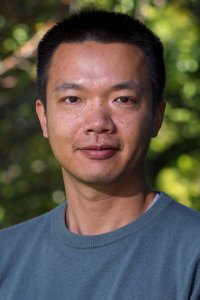
Hanling Guo
Associate Professor in the Department of Mathematics & Computer Science; Computer Science Industry Liaison
By Sasha Fahd ‘28
Ten years of Los Angeles traffic gave Dr. Hanliang Guo plenty of time to wonder whether changing lanes was worth the trouble. Eventually, the question became a research project.
Guo is an Associate Professor in the Department of Mathematics & Computer Science at OWU and a Shankland Award recipient in mathematics. His project captures something he wants colleagues outside his discipline to understand about applied mathematics: the questions often begin with experiences you share.
When asked what faculty might not know about his work, Guo first gives his colleagues credit. Many already know what he studies. But he also recognizes a familiar image of mathematics, a professor at a blackboard working through an equation with little apparent connection to anything beyond it. His research offers a more accessible starting point.
“Usually we start from something that we care about in life,” he explains.
In traffic, that meant asking whether switching lanes actually improved a driver’s progress and whether any advantage justified the extra effort. Thus, his modeling could be used to analyze the problem in ways more than just an intuition that the other lane is always faster.
Sometimes, the questions that Guo has, connect with subjects beyond math. From his graduate school years, Guo has been working on cilia, which are the small hair-like structures on cell membranes that help move fluids. This interest contributed to a research project focused on Stentor, a single-cell organism using cilia to create feeding currents.
He is currently working with two students on simulations examining how the shape of bacterial flagella affects swimming speed and direction. These projects give students a concrete view of how mathematical methods can contribute to questions they might expect to investigate only in a biology lab.
“You can address biological questions with math,” he emphasizes.
That connection between a method and its use also shapes Guo’s award-winning teaching. In differential equations, he wants students to recognize possibilities for investigation in their everyday surroundings. His ambition is for them to look around campus and see situations that they could model themselves.
His enthusiasm comes from using the tools he teaches. Although Guo never took a dedicated differential equations course as an undergraduate, he utilized them extensively in graduate research. Now, that experience helps him explain their purpose to students.
“I can see why it’s important,” he says, “because I’ve been using that every day.”
For faculty across disciplines, he offers an approach for a useful teaching practice. He says to bring students into the questions that make a method worth learning. Guo’s research helps supply the conviction behind his teaching, that scholarship and classroom work continually inform each other.
Sometimes, he says, the clearest evidence arrives after a course ends. A former numerical methods student posted a visualization of a class solution online after graduating. Guo was delighted that the student still found the work worth revisiting and showing to others.
Getting students to that point takes some patience. Guo credits his doctoral advisor’s kindness with shaping his mentorship, and he tries to offer students the same encouragement. He acknowledges that small milestones deserve recognition, even when the work seems straightforward to someone with years of experience.
“There are things that I can do in 10 minutes [that] take students two hours,” he acknowledges. “But that’s the process.”
“[The] younger generation and … my generation too, we need the encouragement and we need the small celebrations … [to] know that we can do meaningful things,” he reflects.
His research asks how things move. His teaching requires knowing when to let students set the pace, giving them time to work through a problem and discover what they can do with it.
For Guo, the reward is watching students begin to trust their own abilities. “As long as they learn something, I’m happy,” he says. “That’s why I’m here.”