

Celebrating Faculty Scholarship: Mark Allison on His New Carlyle Edition

By Sasha Fahd
When asked what he would tell a colleague beginning a long scholarly project, Dr. Mark Allison starts with breakfast: “Eat your Wheaties.”
Then comes the deeper advice: “All projects take longer than you think they will.” Allison recently co-edited a new edition of Thomas Carlyle’s Latter-Day Pamphlets with fellow scholar Chris Vanden Bossche. Preparing it involved much more than bringing an old book back into print.
Behind the volumes are decisions about which references to track down, and discoveries that create more work just when an editor might hope to be finished. His account offers fellow faculty a look inside that process–and a candid reflection on how to sustain a project of their own.
The finished books arrived in the mail about three weeks before our conversation. Allison opened the box, and there they were: the two volumes of Latter-Day Pamphlets, looking rather more composed than the work of producing them had sometimes felt.
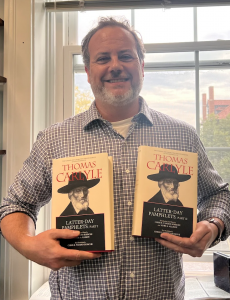
Now, in his small office on the second floor of Sturges Hall, Allison sits in front of his computer, and I pull up a chair opposite him. Stacks of books are piled around the room with just enough space for a reading chair. I am here on behalf of the Smith Center for Faculty Excellence to discuss the Ohio Wesleyan English professor’s newly published work and the scholarly life behind it.
Carlyle is the nineteenth-century writer that Allison has brought into our conversation about scholarly editing. An essayist, historian, and social critic, Carlyle wrote forcefully about what he thought was wrong with British society, influencing writers such as the novelist Charles Dickens along the way. Latter-Day Pamphlets, first published in 1850, gathers some of his fiercest attacks on the institutions and leadership of his time. It is also writing that makes considerable demands on anyone attempting to preserve and explain it.
For Allison, whose research explores nineteenth-century British literature and its relationship to political ideas, those demands reach into questions that have long interested him: how writers understand their societies, imagine alternatives, and influence the people who come after them. His earlier book, Imagining Socialism, examines those connections across British socialist literature. Carlyle occupies a particularly complicated place in that world.
But before Carlyle became an editorial responsibility, he was a discovery.
Allison first encountered Carlyle’s work in graduate school at the University of Chicago, in Elizabeth Helsinger’s course on fiction and historiography–the study of how history is written. He remembers historical prose that made events feel immediate, inviting readers into the experience. Material that might have sounded “dry as paint” was, instead, “absolutely electric.”
“He writes like no one before or since,” Allison says.
That fascination followed him beyond the classroom. As Allison explored nineteenth-century Britain, Carlyle kept appearing in the work and ideas of other people he studied.
“I kept running into Carlyle everywhere.”
Following those encounters eventually brought Allison to a project concerned with helping other readers make connections of their own. His collaborator, Chris Vanden Bossche, is a professor emeritus of English at the University of Notre Dame, a longtime Carlyle scholar, and editor-in-chief of the larger series to which their edition belongs. The partnership brought Allison’s interests in literature and political thought together with Vanden Bossche’s extensive experience studying and editing Carlyle.
“There was no part (of the book) that Chris Vanden Bossche didn’t have a hand in, and vice versa,” Allison says.
To explain what that collaboration involved, Allison begins with a problem hidden inside an apparently familiar object, the printed book. Well into the twentieth century, producing a new edition often meant resetting its type. Each resetting offered another opportunity for an error to enter the text and, through subsequent printings, remain there. Establishing a reliable edition meant comparing those versions and determining which readings should appear on the page.
But recovering Carlyle’s words was only one part of making them accessible. The writing is crowded with references to other works, some familiar to its original audience but less apparent to readers now. Allison and Vanden Bossche traced those references and supplied explanatory notes, allowing readers to follow connections they might otherwise miss. Their edition also includes early manuscripts, several previously unpublished, making more of the material behind the published work available for study.
“It’s really an opportunity to see how his mind sort of goes everywhere,” Allison says.
For Allison, tracing those details changed the larger picture. Latter-Day Pamphlets has sometimes been understood as evidence of a writer losing his artistic powers. Following its intricate references led Allison toward a more interesting conclusion.
“I think he was still on the top of his game as a stylist and as a writer.”
The contrast is important because the writing’s power accompanied ideas Allison found deeply objectionable. The edition also includes Carlyle’s notorious defense of slavery, which Allison unequivocally condemns. Understanding the author’s literary achievement could not mean overlooking what he used it to defend.
When I ask how an editor preserves such writing without endorsing it, Allison returns to conversations he and Vanden Bossche had from the beginning. They argued about this issue, he says, then clarifies that the arguments were productive. Their introduction would need to explain the work’s historical circumstances while making their own judgment unmistakable.
The commitment was “to be unambiguous about our moral disapproval and our condemnation of what was indefensible in his work.”
That clarity is part of what preservation requires, Allison explains. Removing the objectionable material would leave future readers with a misleading version of the past.
“If we sanitize them and only preserve those parts that we still agree with, we’re distorting them.”
Preserving Carlyle’s writing also meant explaining its influence. Allison became especially interested in how later writers and political thinkers used the pamphlets, sometimes for purposes Carlyle might not have expected. By the end of the nineteenth century, British socialists seeking a more representative government were finding useful ideas in a writer whose arguments could be authoritarian. The introduction grew as Allison followed those unexpected connections.
“Different readers in different moments find resources where we wouldn’t necessarily expect them,” he says.
As Allison discovered more about Carlyle’s influence, he kept adding to the book’s introduction, an example of how a scholarly project can grow beyond its original plans. Following a promising connection can deepen the scholarship while adding another task to the work of finishing it. His advice to colleagues recognizes the effort required to keep going.
“Pace yourself,” he says. “It’s a marathon, it’s not a sprint.” Although, he acknowledges, portions inevitably become sprints. Through both, “you have to be able to maintain your interest.”
Allison also asks fellow scholars to recognize something that can become difficult to see during the more exhausting stretches: the opportunity to spend sustained time with a subject they care about.
“That’s a gift.”
“A lot of people don’t have that as part of how they make their living,” he says, “and so it’s something to be cherished.”
Even the days he describes as “absolutely excruciating” belong to that larger perspective. It helps explain why opening the box brought more than relief.
“There’s also a little sadness, right? Something that you’ve sunk so much time in, to sort of be done with it.”
The work had supplied questions worth pursuing, including questions that complicated Allison’s own understanding of an author he knew well. A finished book marked the end of the project without exhausting the interest that sustained it.
Sitting across from Allison in an office crowded with books, I hear how much remains open. The edition gives other readers a place to begin.
“I’ll never be done with Carlyle,” he says.