Written and drawn by Ella Holtsberry.
In high school, I took AP Latin, in which we had to translate The Aeneid. I already enjoyed the act of translating, of diving into all of the intricacies of what each word could mean or imply in the poem, and I enjoyed the dramatic imagery. I particularly was engaged by the description of the fall of Troy, which Aeneas re-tells to Dido. What drew me in was what my teacher had said to us while we were translating. He brought up the Trojan Horse, the most famous part of the story, and discussed how, because of its ubiquity, it seems absurd to have welcomed the gift into the city. But he (and Virgil) stressed how tired its citizens were of war, how exhausting being under siege was, and how much they just wanted peace. They wanted peace to the point of delusion. It was a very humanizing moment, and it stuck with me how relevant of a theme it still is. I would love to say that this piece is a reference to all that, but truly, it was made for my Latin teacher, who continually allowed me to make gory art for his classroom and express myself. My retelling written on the page is sloppy compared to The Aeneid, as I was focused on the imagery.
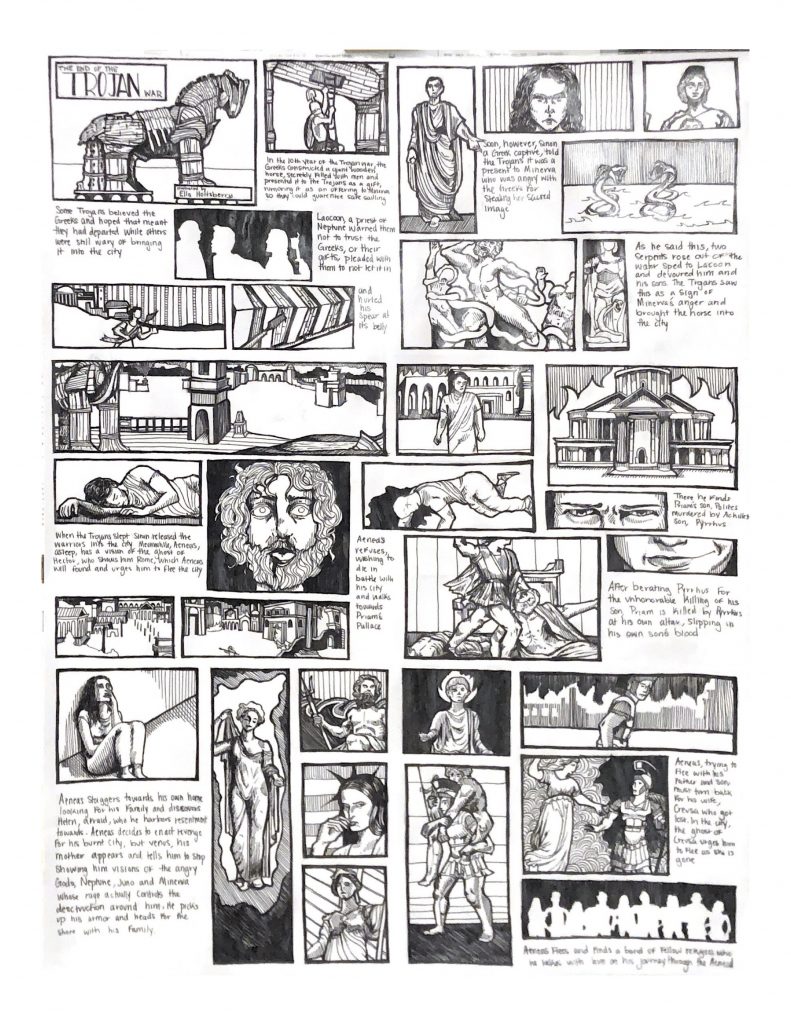
Comic text from left to right: In the 10th year of the Trojan War, the Greeks constructed a giant wooden horse, secretly filled with men, and presented it to the Trojans as a gift, rumoring it as an offer to Minerva so they could guarantee safe sailing. Some Trojans believed the Greeks and hoped that meant they had departed, while others were still wary of bringing it into the city. Soon, however, Sinon, a Greek captive, told the Trojans it was a present to Minerva, who was angry with the Greeks for stealing her sacred image. Lacoon, a priest of Neptune, warned them not to trust the Greeks or their gifts, pleaded with them not to let it in, and hurled his spear at its belly. As he said this, two serpents rose out of the water and sped to Lacoon and devoured him and his sons. The Trojans saw this as a sign of Minerva’s anger and brought the horse into the city. When the Trojans slept, Sinon released the warriors into the city. Meanwhile, Aeneas, asleep, has a vision of the ghost of Hector, who shows him Rome, which Aeneas will found, and urges him to flee the city. Aeneas refuses, wishing to die in battle with his city, and walks towards Priam’s palace. There, he finds Priam’s son Polites murdered by Achilles son Pyrrhus. After berating Pyrrhus for the unhonorable killing of his son, Priam is killed by Pyrrhus at his own altar, slipping in his own son’s blood. Aeneas staggers towards his own home looking for his family and discovers Helen, afraid, whom he harbors resentment towards. Aeneas decided to enact revenge for his burnt city, but Venus, his mother, appears and tells him to stop. Showing him visions of the angry Gods, Neptune, Juno, and Minerva, whose rage actually controls the destruction around him. He picks up the armor and heads for the shore with his family. Aeneas, trying to flee wth his father and son, must turn back for his wife, Creusa, who got lost. In the city, the ghost of Creusa urges him to flee as she is gone. Aeneas flees and finds a band of fellow refugees whom he takes with him on his journey through The Aeneid.
Ella Holtsberry is a Junior at Ohio Wesleyan, majoring in Politics and Government. She enjoys writing poetry, drawing, and occasionally taking photos. She is inspired by anything to do with memory or melancholia.
Featured Image: The Trojan Horse and the Sack of Troy, from the King’s Manuscripts 24 collected in the British Library. This work is in the public domain.