Dr. Blume is an assistant professor of classics, co-director of the OWU Honors Program, and a member of the Department of World Languages and Cultures.
Why are you interested in your field? And what led you to this interest and then pursuing it as a full-time career?
Dr. Blume’s interest first began in middle school, when, through a magnet program, he was able to take Latin. He enjoyed those classes, and then in high school, he had a teacher he really liked who had her PhD in Medieval History. Both of those helped grow his interest, and he noted that when his father saw this interest developing, he encouraged Dr. Blume to go further with it. Dr.Blume’s father had majored in philosophy and previously studied Greek and Latin, so he was familiar with the field. Dr. Blume entered college with an intended major of classics, and by his sophomore year, he knew he wanted to pursue a PhD within the field. He decided on the PhD largely through doing the coursework, stating, “I really liked the reading. Reading upper-level Greek really kind of made me interested in that, and I think I kind of fell in love with the languages, and then just decided that’s what I wanted to do.”
“I think to me it’s sad if we live in a society that doesn’t want to reflect on itself, and where it comes from, and classics is pretty valuable, I think for that reason.”
That being said, Dr. Blume did not originally intend to teach. Rather, he again cited his love for reading: “I got in it because I was like, oh my God, you’re telling me someone’s gonna like, pay me money to read books. I like to read, that sounds great, and then just study and write…”. However, he started teaching during grad school and then as a lecturer, and found that he enjoyed it. And in terms of why teach classics specifically, he said, “I think to me it’s sad if we live in a society that doesn’t want to reflect on itself, and where it comes from, and classics is pretty valuable, I think for that reason.”
Have you had other teaching jobs? What led you to come to Ohio Wesleyan?
Dr. Blume’s previous teaching experience included lecturing for four years at Ohio State, which is where he gained his PhD. Then he came to OWU as a visiting professor for two years, before moving on to the tenure track. Part of the reason Dr. Blume applied to OWU was that he was looking for something in Ohio, around the Columbus area. That being said, he was excited by the idea of teaching in a smaller college, something he had not experienced before, as both the places he attended school were larger. He thought he would enjoy the environment.
What have you incorporated from your previous teaching experiences into your style now? What have you done differently?
Dr. Blume noted that a large amount of things are different by nature of the size difference of classes, with classes at OSU sometimes being nine times the size of a class at OWU. He incorporated ideas he developed at OSU, such as active learning techniques adapted specifically to classics, but maintained that it is still fairly different because of class size. When asked if he had a preference for smaller or larger classes, he mentioned he preferred smaller classes as it gives the opportunity to get to know his students better. He also stated that, “I can treat students in a sort of more advanced fashion, especially classics majors or ancient studies majors.” In regard to larger classes, he noted, “There is something fun about teaching a really large class. It’s exciting, but it’s almost more like entertainment than education in a certain way, because you’ve got to hold the attention of three hundred people for sixty minutes.”
While we’re on the topic of your earlier interests and goals, did the thing you were excited to write your dissertation on start out as your primary interest? What was it?
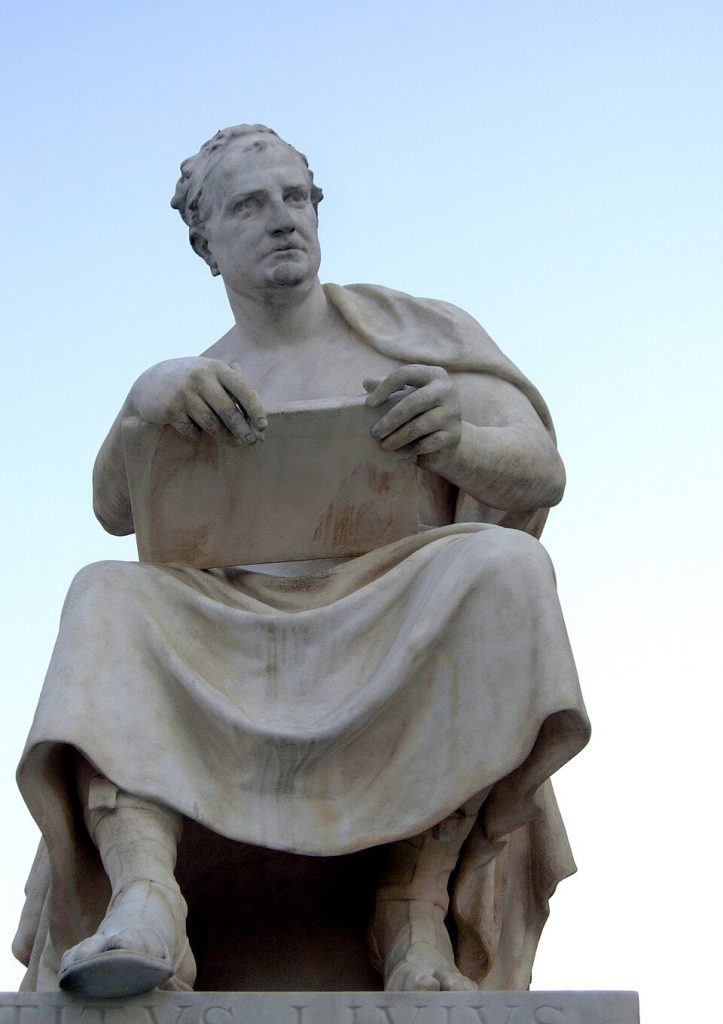
No, Dr. Blume originally went to graduate school to study Ancient Greek religion, something he had gained an interest in during his undergraduate studies. He went to Ohio State with the intention of studying with two specific professors who were experts in ancient religion. However, during the course of his studies and his candidacy exams, he became increasingly interested in emotions in Roman politics. He worked on that topic with a different professor, and as he worked on that, especially during his candidacy exams, he came up with a new dissertation topic that he felt had a much clearer thesis and stronger evidence. He also noted that what he had been interested in within Greek religion had been done recently and very well by another scholar, and in a relatively niche field, it wouldn’t benefit him to do the same thing. Instead, he wrote his dissertation on “how fear, anger, and hatred affect political decision-making in the first six books of Livy.” While not what he originally went to study, he explained that it is actually very common for people to switch topics as they do more research.
What do you consider to be some of the best or most fulfilling parts of your career?
“I think right now is actually one of them.” Dr. Blume was referring to how a lot of the current classics majors are pretty advanced in their language capabilities. Part of that growth has come from those majors doing work outside of the normal classics track, having taken the courses necessary for the major but then continuing to take additional language courses. “The fact that they’ve done that and have advanced so far is really fulfilling, to see them progress as they have over the past three or four years.” Dr. Blume also referenced another moment of student growth, from one of his earlier years as a professor, as a fulfilling moment. He talked about being one of the professors to produce a student who causes you to think, “Well, this person is just going to be a better scholar than I’ll ever be,” and what a pleasure that is. He mentioned that getting to see that person grow and go on to graduate school was very fulfilling, knowing what a phenomenal scholar they’ll be.
Has your career justified any fun travel? What places have being a professor taken you to?
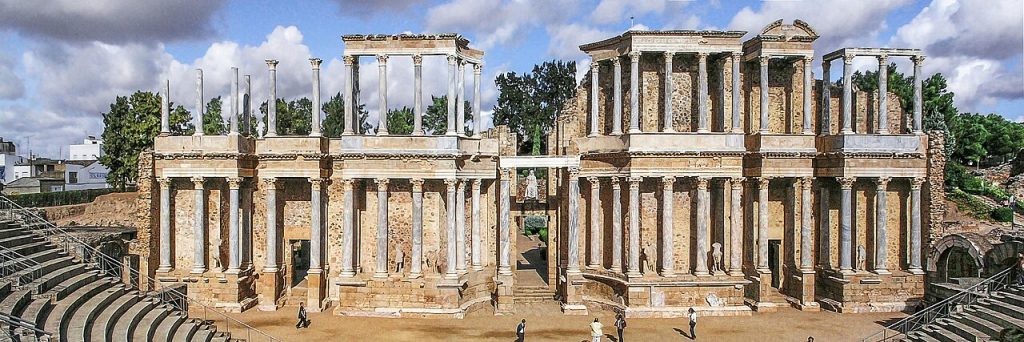
Dr. Blume has gone to Spain twice since coming to Ohio Wesleyan, for his own research and for research for a travel learning course. He’s been basically all over Spain, something he said he would not have envisioned a few years ago, and it’s been very nice to be able to become so familiar with Spain. He has done some travel for work conferences as well, but stated his experiences in Spain as the main travel his work has allowed for.
You mentioned plans for a travel learning course. Where do you plan to go, and what will the focus of the class be?
Dr. Blume is offering a travel learning course in the Spring of 2027 to Spain. The course itself is about the relationship between empire and ethnicity, and how the two interact and shape each other. Part of that relationship is a focus on “the spread of romanization and the romanization of peoples in provinces and Spain is a very good example of that.” The travel learning course will be pretty wide-ranging; students will go from Northwestern Spain to South and Southern Central Western Spain, around the border of Portugal. In Northwestern Spain, there are dense Roman mines, gold mines specifically. There will be several visits to Roman colonies, such as one in southern central Spain, one outside of Seville, and one on the Mediterranean coast. He said the purpose of this is to, “let students see the extent of Roman colonization, but also the amount of exploitation there that happened to the local Spanish population.” He wants students to be thinking about, “why Spanish people want to relate their ethnicity or see so much of their cultural history in the Romans, when biologically modern Spaniards are the same people that the Romans were enslaving by the thousands. Yet, modern Spaniards still think of themselves, to a degree, as inheritors of Rome.”
“Living in America, someone says this building’s old, and it’s from the Civil War. Then you go there [Spain], and the building is 2,000 years old.”
When asked about the benefit for students to go and see the places for themselves, versus just hearing about it, he said that it is something hard to grasp if you’ve never seen Rome and extensive ruins up close. He explained, “Living in America, someone says this building’s old, and it’s from the Civil War. Then you go there, and the building is 2,000 years old.” He also explained that it’s harder to just look at a map and get the same understanding of how broadly they were expanding, and how influential they were. Beyond that, there are also a lot of things that one can’t see online, and it is always a great opportunity to be able to experience another culture.
You’re going on sabbatical in the spring. What are you planning on doing? What do you hope for it to lead to?
Sabbaticals are extended periods of leave from one’s profession, in which, for professors, they typically work on research, scholarly writing, and/or professional development. Dr. Blume’s sabbatical will be spent writing and furthering his own research. There are three articles that he will be working on specifically. One is on the right of appeal in the Roman Republic, another about the execution of women in the Roman Republic, and the last one is about envy and hatred in Roman politics.
How do you go about coming up with new ideas for classes to teach?
Dr. Blume explained that for him, he tries to balance what is happening in the broader Zeitgeist with the actual content requirements that have to be covered. Ultimately, however, Dr. Blume said that he asks himself, “What is something you really want your students to be able to explore, or that you think it’s important for them to explore?” He described how he could have a class about the Roman Empire, which could look like just a broad overview of the history of the Roman Empire. Or, he could design a course like the ethnicity and empire course, in which students are really meant to be taking away how those interact. Within seeing how ethnicity and empire interact, or any overarching point of class, he stressed, “It’s not just to see how that works in the ancient world, but so they can think about their own situation. It’s about using the ancient world as a lens to do that.” He reiterated that it always starts with thinking of a question he thinks is important for students to understand. In terms of coming up with those types of questions, he stated that he reads books and articles and pays attention to modern-day political issues, etc. Then it’s about working that into the information that a classics student would be expected and required to know.
Are there any classes you haven’t taught yet, and would like to, or any ideas for classes that you’re planning on developing?
Dr. Blume spoke about a class he is offering this fall, called Classics and the American Empire. The course would cover three periods: the pre-revolutionary war and the foundation of America, the Antebellum, Civil War, and immediately post-Civil War period, and then a more modern use of classics in contemporary politics. The idea of this class is to “explore the way the Classics helped develop or influence the shape of America.” For example, he spoke about how in the South, the classics were used to perpetuate the slave holding class.
He also spoke briefly about another class he will be offering this fall, Gender and Sexuality in Classical Antiquity. He mentioned it as a class that is interested in identity, and in part, reframing it. It is something he said that he would hope to be able to expand, for example, thinking about ethnicity and slavery.
An idea he was still developing was one on falsehoods in the ancient world that are still present, and information that it had caused people to believe about the ancient world that isn’t necessarily or entirely true. He mentioned that the idea was really only half developed, but that “it seems fun”, and he would design it as an “information exploratory course”, rather than strictly a historical content course.
The last course that Dr. Blume mentioned considering was about classical literature and its reception. He mentioned that it was initially proposed as something that not only he could teach, but that could also be taught by the broader AMRS faculty. It would be interesting, as there would be a different perception perhaps from a Medieval perspective versus a Renaissance perspective, instead of only looking at it through a classical lens.
When you’re teaching your classes, you’ll have a mix of students between majors and non-majors. For those without a specific interest in the subject, what are you hoping for or trying to get them to take away? Does it differ for those with specific interests? If so, how & why?
Yes, it does differ. He explained that for him, for non-majors or minors, it’s not the most important thing to him that they remember, for example, the basics of the Second Punic War. Instead, what he wants them to get out of his classes is a “toolkit with which they can analyze their own world, or subject, or literature, in the future.” He elaborated, saying he hopes students develop, “for whatever the class might be, some sort of moral ethical framework with which to live your life or analyze your life or your society. That’s the value ultimately about a humanities education, a liberal arts education.” However, for majors and minors, there is content that they are expected to have down, and will need in order to succeed in subsequent courses. Especially, if they want to go to graduate school, where they will need previous information for context for papers and research. The exception is his language courses in Latin and Greek. There is a minimal difference, if there is a difference at all, between majors and non-majors when taking a language class. He clarified that this is because to succeed in a language class, all students are expected to commit the language to long-term memory.
“…for whatever the class might be, some sort of moral ethical framework with which to live your life or analyze your life or your society. That’s the value ultimately about a humanities education, a liberal arts education.”
Lastly, how does being a classicist impact your modern life? Does it influence how you think about things or perceive them? Does it play any role in your actions?
Dr. Blume mentioned the skills that he felt being a classicist helped him develop, such as attention to detail, critical analysis, and critical thought. Furthermore, he said that it creates a specific lens through which he views things. He stated that when you read and study Roman politics, it does create a fairly cynical viewpoint of institutional power, which does tend to affect the way he sees things overall. Beyond that, however, he said, “It has made me like the type of thinker that I’ve become. Whether or not I could go back in time and redo any of this or not redo any of this, I enjoy the type of thinker I have become because of it. I think it affected the way I think about the world, I think about literature, about politics, even just the way I read books. I enjoy that, but I also don’t know at this point what it would be like otherwise.”
Featured Image: Ancient Rome by Giovanni Paolo Panini, 1757. This work is in the public domain.
Images: Titus Livius statue created in1874-1883. This image is free to use under CC Attribution 4.0 International License.

Roman Theatre in Mérida, constructed in 16-15 B.C. This image is free to use under Creative Commons Attribution-Share Alike 3.0 Unported license.

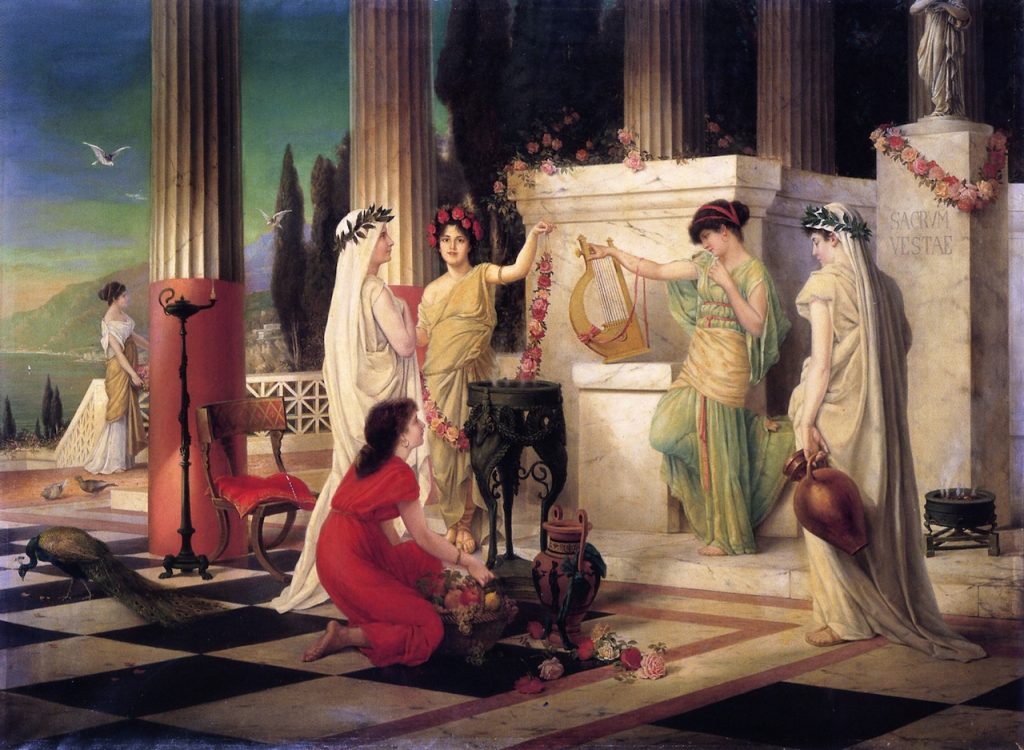
In the Temple of Vesta by Constantin Holscher, 1902. This work is in the public domain.